How the Space Economy Will Reshape Everyday Life, Risk, and Power
About this site
Editor: Mike Bacotti, founder of SpaceOrbitals. Mike launched the editorial desk in 2024 to cover commercial space — launch economics, satellite operators, ground equipment — and astronomy gear (telescopes, mounts, cameras, software) for hobbyists and professionals.
Launched: SpaceOrbitals went live in as an editorial desk covering orbital mechanics, the space economy, and the gear that gets us there. The full authors team is documented on the authors page.
Credentials: The desk draws on formal coursework in aerospace engineering, mission operations experience at a major launch provider, certified telescope operation, and business journalism covering the space economy since 2020. Author credentials are listed on each author page.
Editorial process: Each piece distils manufacturer spec sheets, FCC filings, and hands-on testing (where applicable) into the worked-example frame: what it is, who it's for, how it compares. News items are cross-checked against at least one confirming source — operator statement, regulatory notice, or industry filing — before publication.
Corrections policy: When a piece gets a fact wrong, we correct it inline and append a dated correction note at the top of the affected page. Substantive corrections credit the reader by name unless they ask to remain anonymous. Send corrections to the editor.
Disclosure: SpaceOrbitals is review and commentary, not advice. We do not accept payment for coverage, sponsored content, or advertorial. Affiliate links, where present (Amazon Associates), are tagged rel="sponsored nofollow" and disclosed at the top of the relevant piece; this does not affect our editorial assessment.
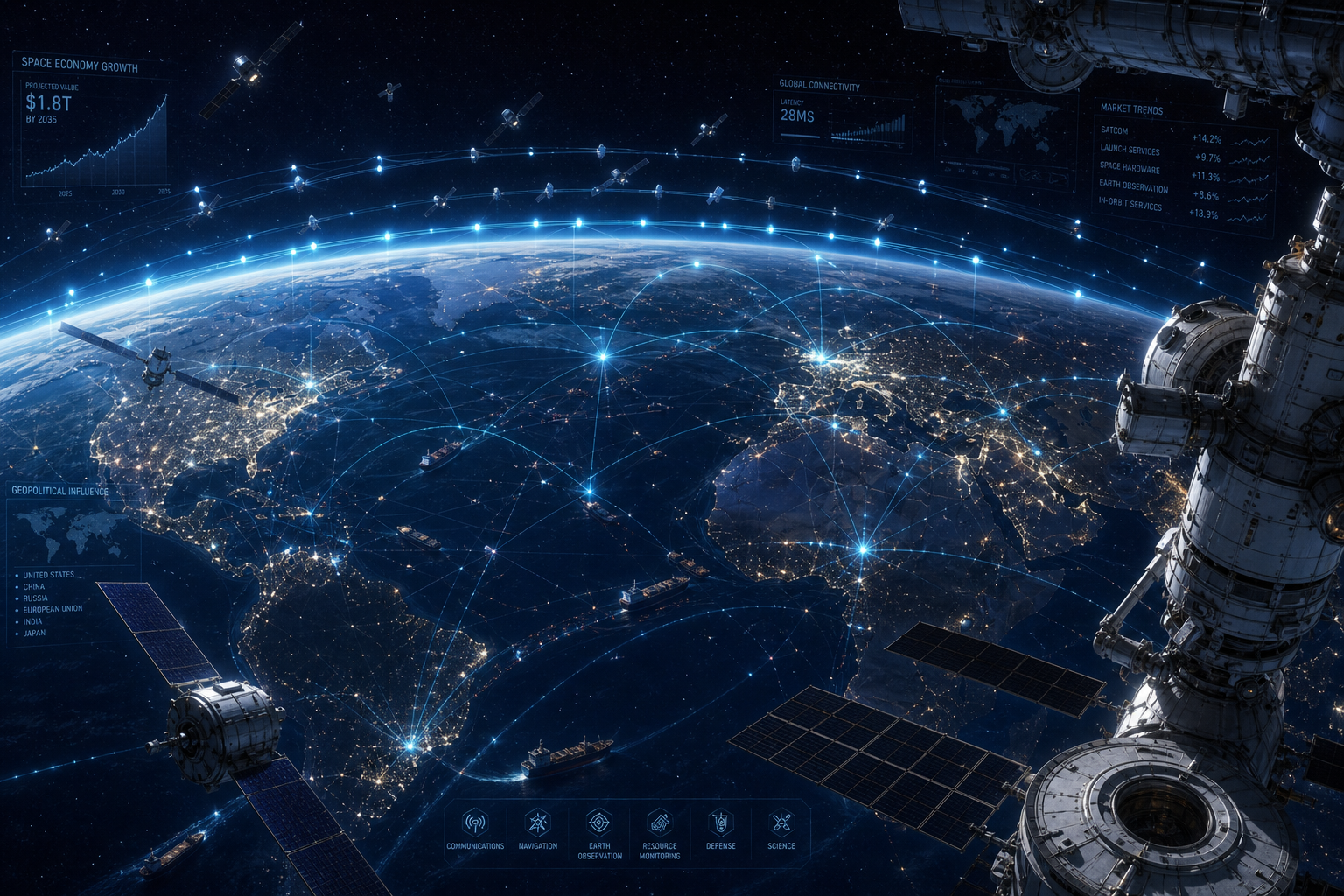
Over the next 10 to 20 years, the most important economic revolution in your life may not happen on Wall Street, in Silicon Valley, or even in your country. It will happen above your head -- inside an expanding shell of satellites, stations, and spaceborne factories quietly rewiring how Earth works.
This emerging "space economy" is no longer just about heroic astronauts or prestige missions. It is about infrastructure: networks of orbiting machines that carry your data, watch your fields, time your financial trades, route your containers, and help decide who has power and who remains in the dark.
In this article, we will explore how that invisible infrastructure will reshape everyday life, risk, and power -- from your internet connection to your job prospects, from geopolitical stability to your sense of meaning in a planetary civilization.
The Invisible Lattice Above Your Head
Stand outside at night and look up. You might see a few bright points sliding silently across the sky: Starlink trains, Earth-observation satellites, perhaps a spent upper stage catching the Sun. What you do not see is the underlying pattern: a rapidly thickening lattice of orbital hardware that is starting to function like a second nervous system for Earth.
The modern space economy already stretches far beyond rockets and astronauts:
- Satellite communications. Broadband networks like Starlink and others are wiring remote regions and underpinning a growing share of global data traffic.
- Earth observation. Constellations of imaging and radar satellites watch crops, ships, forests, and cities in near-real time, providing critical data for finance, agriculture, climate monitoring, and security.
- Navigation and timing. Global navigation satellite systems (GNSS) like GPS provide precise timing for power grids, telecom networks, banking transactions, and logistics.
- Launch and in-orbit services. Reusable rockets, rideshare missions, and new servicing vehicles are lowering the cost of placing and maintaining assets in orbit.
The global space economy is projected to reach roughly $646 billion by 2030, growing around 8 to 9 percent annually, driven largely by satellite-based communication and services rather than exploration "for its own sake." Most of this activity is invisible to ordinary citizens -- until something fails. A GPS glitch, a satellite outage, or a connectivity blackout reveals how deeply your world already depends on infrastructure you rarely think about.
In the coming decades, this orbital lattice will grow denser, more commercial, and more entangled with ground systems. That is where everyday life, risk, and power begin to shift in subtle but profound ways.
Markets When Every Market Has an Orbit
Economists sometimes talk about "general-purpose technologies" -- inventions like electricity or the internet that quietly transform every sector they touch. The evolving space infrastructure is on track to become such a technology.
Data from orbit becomes a default input
Satellite data is shifting from an exotic specialty input to a default assumption in multiple industries:
- Agriculture. Multispectral images reveal crop health, soil moisture, and pest outbreaks; farmers and agribusinesses can adjust irrigation, fertilizer, and supply contracts more precisely.
- Shipping and logistics. Real-time vessel tracking and port congestion imagery reshape freight pricing and routing decisions.
- Energy and commodities. Satellite observations estimate oil storage levels, monitor pipelines, and track mining activity, feeding directly into trading models and risk assessments.
For investors and businesses, this means:
- Alpha from space narrows. Once only a few hedge funds could afford bespoke satellite data; as services commoditize, "space-derived" insights become table stakes.
- New data asymmetries emerge. Entities with privileged access to certain orbital datasets or analytics may see a structural advantage in specific sectors or regions.
For ordinary workers and consumers, the effect is indirect but real. Food prices, shipping delays, and even local job markets will increasingly reflect decisions based on orbital data you never see.
Space-mediated finance and insurance
As satellites become more tightly coupled to Earth systems, finance must evolve to price new kinds of risk and opportunity:
- Catastrophe and climate risk. Earth-observation data refines models for floods, fires, storms, and sea-level rise, which affects insurance premiums and property valuations.
- Space-specific risk products. Insurers are already underwriting satellite launches and operations; as constellations proliferate, derivatives and reinsurance around orbital risk become more sophisticated.
Over time, you may see:
- Mortgage rates and insurance terms that incorporate satellite-derived climate risk scores for your neighborhood.
- Pension funds and index products with explicit exposure to "space infrastructure," treated like a new asset subclass akin to telecom or utilities.
The space economy will not be a separate industry sitting on the side. It will become part of the core plumbing of markets, invisible until its absence is felt.
Everyday Life Under a Space-Mediated Sky
For most people, the space economy will matter not because they ever go to space, but because life on Earth will increasingly flow through orbital infrastructure.
Connectivity without geography
Low Earth orbit (LEO) constellations aim to provide broadband connectivity nearly anywhere on the planet, with latency comparable to -- or better than -- many terrestrial networks.
That creates several shifts in everyday life:
- Remote communities gain access. Villages, ships, research stations, and rural households that were effectively offline gain reliable connectivity, enabling remote work, telemedicine, online education, and e-commerce.
- Mobility becomes less tethered. Travelers, digital nomads, and mobile workers can maintain robust connections far from traditional infrastructure.
- New digital inequalities. Connectivity gaps shrink geographically, but new divides emerge between those who can afford premium space-based services and those stuck with congested or monitored terrestrial networks.
As more of your social, economic, and informational life is mediated by space-based networks, the line between "on-grid" and "off-grid" changes. Being offline may become a conscious choice rather than a default condition for the poor.
A planet under continuous observation
Imagine a world where, for most populated regions, high-resolution imagery and sensor data are updated multiple times per day. That world is arriving.
Earth-observation companies already offer:
- Crop and forest monitoring for large landowners and governments.
- Real-time tracking of ship movements, construction sites, and even traffic patterns.
In the next 10 to 20 years, this intensifying observation will affect:
- Privacy and surveillance. While current commercial imagery does not show individual faces, patterns of activity at homes, workplaces, and communities could be inferred. Governments and corporations may use such data to monitor compliance, detect "anomalies," or enforce policies.
- Accountability and transparency. The same tools can expose illegal deforestation, secretive troop movements, or environmental violations, empowering activists and journalists.
Living under a space-mediated sky means living with a new kind of visibility: less about being seen by your neighbors, more about being readable as a pattern in orbital data.
Time, attention, and the orbital rhythm
You already live by hidden time standards -- most digital systems synchronize through satellite-based timing signals. As space infrastructure grows, its rhythms may subtly reshape your experience of time and attention:
- Always-on global markets. With low-latency connectivity everywhere, the idea of "market hours" or "business hours" erodes further; people in remote regions may find themselves pulled into 24/7 rhythms of work and trade.
- Planetary events in real time. Launches, docking, re-entries, lunar landings, and on-orbit incidents become collective experiences, livestreamed into homes and devices worldwide.
Your sense of "now" will stretch outward: not just what is happening in your city or country, but what is happening in orbit and on the Moon as those domains become part of everyday news and concern.
Power: The New High Ground Is Orbital
Space has always been the ultimate high ground in military and geopolitical terms. What changes in the new space economy is who controls that high ground and how deeply it is integrated into civilian life.
States, corporations, and orbital dependency
Historically, space was the realm of superpower states. Today, private firms own and operate much of the critical orbital infrastructure: communications constellations, imaging fleets, and launch systems.
That creates a new triangle of power:
- States rely on private infrastructure for communications, navigation, and intelligence -- even in conflict zones.
- Corporations gain leverage by controlling key nodes in that infrastructure; their decisions can influence wartime outcomes and domestic politics.
- Citizens and smaller states become increasingly dependent on services governed by foreign or extraterritorial corporate policies.
A recent example is the dependence of military operations and civilian communications on privately operated satellite internet services in conflict regions, putting unprecedented political weight on a corporate actor's technical and policy choices.
In the next two decades, similar dynamics will multiply:
- Decisions by constellation operators about coverage, throttling, or prioritization could shape civil unrest, election integrity, and even disaster response.
- Regulatory battles over spectrum, orbital slots, and antitrust will determine whether a few firms dominate space infrastructure or a more pluralistic ecosystem emerges.
The question "Who owns the sky?" becomes less metaphorical and more literal.
Orbital conflict and strategic vulnerability
As more critical services depend on satellites, those satellites become targets.
Risks include:
- Anti-satellite weapons (kinetic or cyber). Disabling or degrading constellations could cause cascading effects on navigation, finance, communications, and military operations.
- Orbital debris and "Kessler syndrome." Collisions could render key orbital bands hazardous or unusable, damaging infrastructure and constraining future launches.
These vulnerabilities create a paradox:
- On one hand, space infrastructure can make societies more resilient by improving forecasting, coordination, and redundancy.
- On the other, it creates new single points of failure -- if you lose satellites, many ground systems falter in ways they would not have 30 years ago.
In geopolitical terms, states will increasingly calibrate their diplomacy and military planning around the mutual vulnerability of space assets, much as they once did around nuclear deterrence.
Risk in a Space-Mediated Civilization
Risk is not just about what can go wrong, but about what we choose to care about. As the space economy matures, both systemic and personal risk profiles will shift.
Systemic risks: new failure modes
Key systemic risks include:
- Orbital congestion and debris. Thousands of satellites increase collision probability; debris can damage other assets and trigger chain reactions.
- Solar and geomagnetic storms. Intense events can disrupt satellites and power grids simultaneously, threatening navigation, communications, and infrastructure.
- Concentration risk. If essential services are concentrated in a handful of constellations or operators, any failure -- technical, economic, or political -- has outsized impact.
The challenge is that these risks are hard for everyday citizens to see or intuit. They are abstract and global, not local and visible.
Personal risks and choices
For individuals, the risk landscape will shift along several axes:
- Career risk. Some professions -- space law, orbital operations, space-derived data science -- will grow; others may be disrupted by better satellite data and automation in logistics, agriculture, and resource industries.
- Information and attention risk. Living in an always-on, space-mediated information environment intensifies exposure to misinformation, manipulation, and cognitive overload.
- Privacy risk. Patterns of movement, land use, and even economic activity may be inferred from orbital data, raising questions about consent and oversight.
You may never buy a satellite, but you will increasingly make decisions -- where to live, what to work on, how to invest, which platforms to trust -- in a world shaped by risks that originate in orbit.
Meaning: Who Owns the Story of Space?
Beyond markets and power struggles, the space economy also raises questions of meaning. Why are we building this infrastructure? For whom? What stories do we tell to justify and guide it?
From Cold War prestige to commercial myth
The old narrative of space was national prestige and scientific exploration: flags, footprints, and pictures of distant worlds. The new narrative is more commercial and diffuse:
- "NewSpace" entrepreneurs frame space as the next frontier for growth, innovation, and even planetary survival -- colonization as a hedge against extinction.
- Investors see space infrastructure as a platform for new industries and returns, analogous to early internet infrastructure.
Yet there are competing stories:
- Critics emphasize unresolved problems on Earth, arguing that space projects can distract resources and attention from inequality and climate change.
- Others worry about the extension of extractive economic logics into new domains, treating orbital slots, lunar resources, and planetary defense as territories to be commodified.
The story that wins -- heroic frontier, controlled commons, corporate empire, or something else -- will quietly steer regulation, funding, and public acceptance.
The psychological impact of being a space-mediated species
As launches, space stations, and lunar missions proliferate, you will be exposed to a new normal: Earth not as isolated home, but as one node in a broader human footprint.
This shift can have several psychological effects:
- Expanded identity. Some people will feel a stronger sense of planetary or even species-level identity, seeing borders as less central than shared vulnerabilities and ambitions.
- Heightened anxiety or awe. Others may experience existential unease at the thought of fragile orbital systems, hostile environments, and the scale of cosmic indifference; still others will find meaning in participating, even indirectly, in a larger human story.
Your own experience of time, purpose, and responsibility may be reshaped by the knowledge that decisions on Earth are now entangled with permanent infrastructure in orbit and beyond.
Navigating the New Orbital Order: A Practical Lens for Citizens
You do not need to be a rocket scientist, investor, or policymaker to navigate the space economy era more consciously. But you do need a framework.
Four questions to ask about any space-related development
When you read about a new satellite constellation, lunar mission, or orbital service, consider:
- What ground systems does this actually affect?
Does it reshape communication, logistics, finance, surveillance, or environmental monitoring in a concrete way?
- Who controls it, and who regulates it?
Is this infrastructure public, private, national, or transnational? How accountable are the operators?
- What are the second-order effects on everyday life?
Might it alter job markets, privacy norms, or the distribution of opportunity between regions?
- What narratives are being used to justify it?
Are we told this is about security, growth, survival, exploration, equity? How do those claims align with the underlying incentives?
These questions help separate spectacle from substance and highlight where your interests as a citizen align -- or conflict -- with those of states and corporations.
Where you have agency
Even in a domain dominated by large actors, individuals and small groups can influence:
- Policy and oversight. Public pressure and expert engagement can shape national and international rules on orbital debris, spectrum allocation, and corporate power in space.
- Professional choices. Career moves into or adjacent to the space economy (data analysis, policy, engineering, law, design) help diversify who designs and governs this infrastructure.
- Cultural narratives. Writers, filmmakers, educators, and activists can craft stories that emphasize responsible stewardship, shared benefit, and humility rather than conquest or escapism.
The space economy is not just a technical or financial phenomenon. It is a collective choice about what kind of civilization we want to become.
Looking Up with Clear Eyes
Over the next 10 to 20 years, the space economy will expand from a specialized sector into a pervasive layer of infrastructure that shapes markets, politics, and everyday lives.
- Your food, news, navigation, and risk models will depend more heavily on orbital data.
- New forms of inequality, leverage, and vulnerability will arise from who owns and governs infrastructure in orbit.
- Your sense of time, identity, and meaning will be subtly reshaped by living in a civilization that increasingly extends beyond Earth's surface.
To navigate this era thoughtfully, you do not need to memorize rocket specifications. You need clear conceptual tools: an understanding of invisible infrastructure, second-order effects, systemic risks, and cultural narratives.
The sky above you is filling with machines that will help decide what is possible on the ground. Looking up with clear eyes -- and asking better questions about life, risk, and power in a space-mediated world -- is no longer science fiction. It is part of being an informed citizen of the 2030s and 2040s.
Recommended reading
If you want to go deeper into the business and economics of the space industry, these are the books most cited by analysts and operators working in the sector today.
- The Space Economy: Capitalize on the Greatest Business Opportunity of Our Lifetime by Chad Anderson (Wiley, 2024) -- the most-cited 2024 primer on the commercial space sector from the founder of Space Capital. Investor's view of where capital is flowing, how the next decade of the space economy is likely to unfold, and the categories (launch, satellite, in-orbit services, data) where returns will concentrate. (Where to buyThe Space Economy: Capitalize on the Greatest Business Opportunity of Our LifetimeASIN: B0CKMVT4Y4View on AmazonManufacturer ↗">Amazon)